Types of Cladding Compared — Ghana Guide
Which cladding should you choose? An honest Ghana comparison of every system — ACP (PE/FR/A2 fire cores), ceramic & porcelain ventilated, terracotta rainscreen, HPL, fibre-cement, natural stone veneer, zinc/copper standing-seam and WPC/timber — with a side-by-side look/durability/fire/cost table and how to choose by climate, fire requirement, budget and building type. Cladding Ghana, since 1983.
Cladding is not one product — it is a family of systems that look similar from the street and behave completely differently on durability, fire and cost. Choosing the right system is the whole decision, and it is made against the building, not on the lowest sheet price. Cladding Ghana has specified and installed façade systems across Ghana since 1983, and we are deliberately system-agnostic: our job is to put the right cladding on your building, name it in writing, and tell you the honest trade-offs.
How to Read This Guide
Every cladding system trades one quality against another. A material that gives a beautiful natural look may cost more or weigh more; a low-priced sheet may fade in Accra’s sun or — if it is a combustible core — be wrong for a tall building entirely. There is no single “best” cladding. There is only the best cladding for this building, in this climate, under this fire requirement, at this budget. The sections below walk each system, then the comparison table puts them side by side, then “How to Choose” gives you the order to decide in.
The Cladding Systems
Aluminium Composite Panel (ACP / ACM)
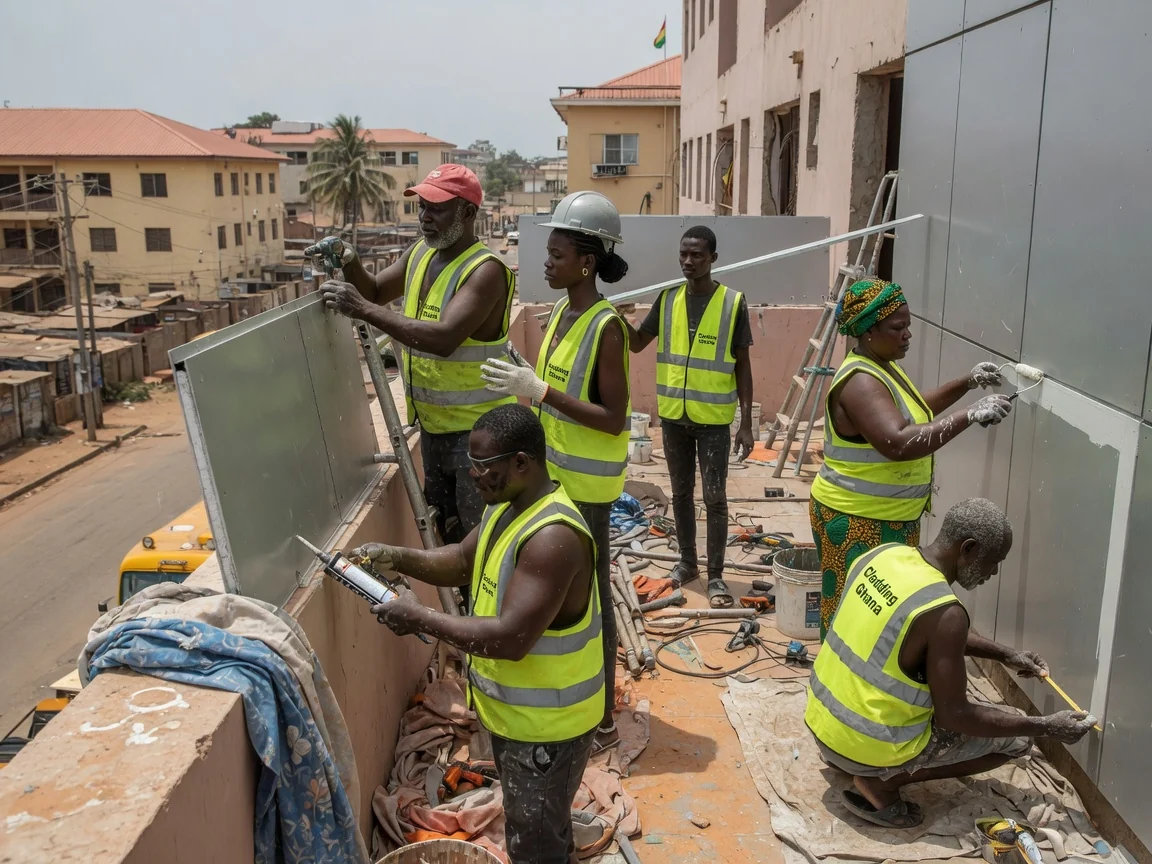
Two thin aluminium skins bonded to a core, in flat panels that give a clean, modern corporate look in almost any RAL or anodised finish. The core decides the fire behaviour: a PE (polyethylene) core is combustible — the material involved in the Grenfell Tower fire; an FR core is fire-retardant (~70% mineral filler); an A2 core is mineral-filled (>90%) and classified A2-s1,d0 (limited combustibility) under EN 13501-1, the highest fire rating an ACP achieves. ACP is light, fast to fabricate and the default for commercial towers — but only when the core is named and specified to the building.
Ceramic & Porcelain Ventilated Façade
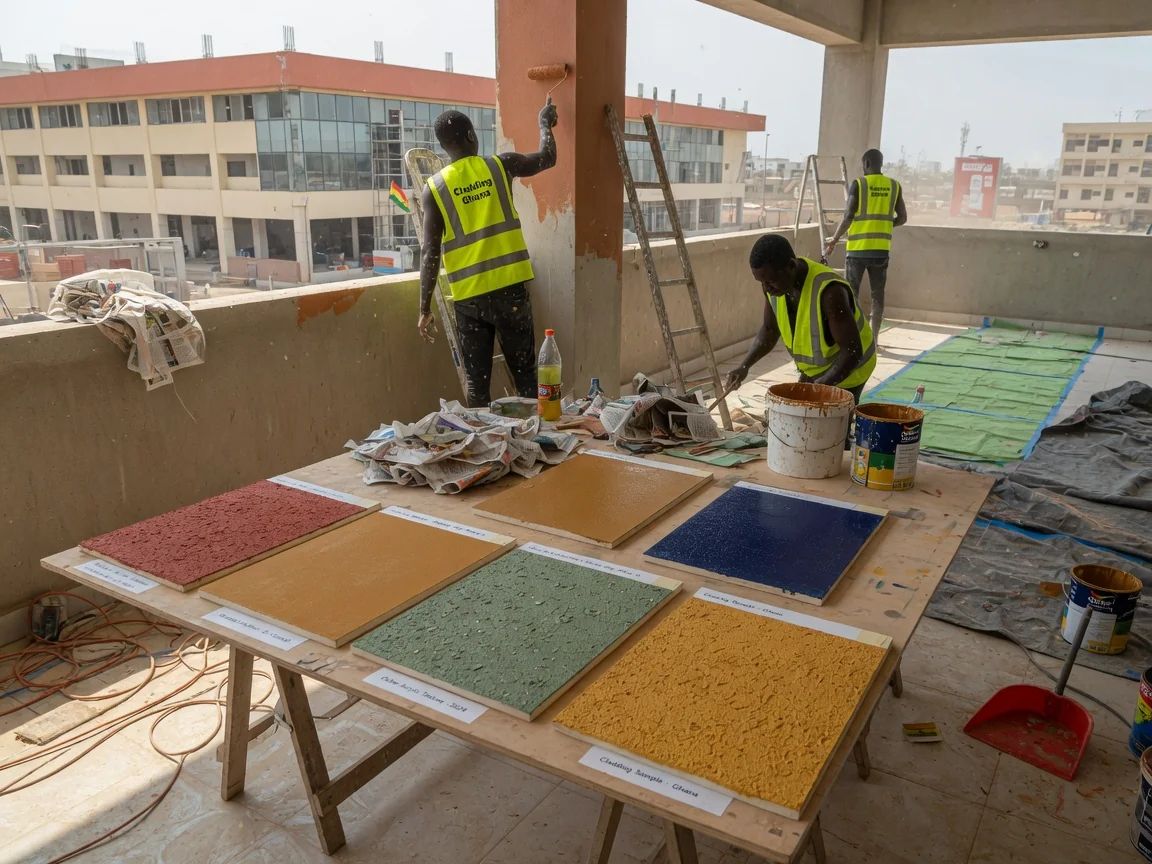
Large-format porcelain or ceramic tiles hung on a ventilated sub-frame to EN 14411 (the porcelain/ceramic tile standard). Inherently non-combustible, dimensionally stable, fade-resistant and very low-maintenance — porcelain shrugs off Accra’s sun, coastal salt and humidity. A premium, durable institutional finish with a wide range of looks from stone-effect to flat colour. Higher material and fixing cost, and the panels need careful handling.
Terracotta Rainscreen
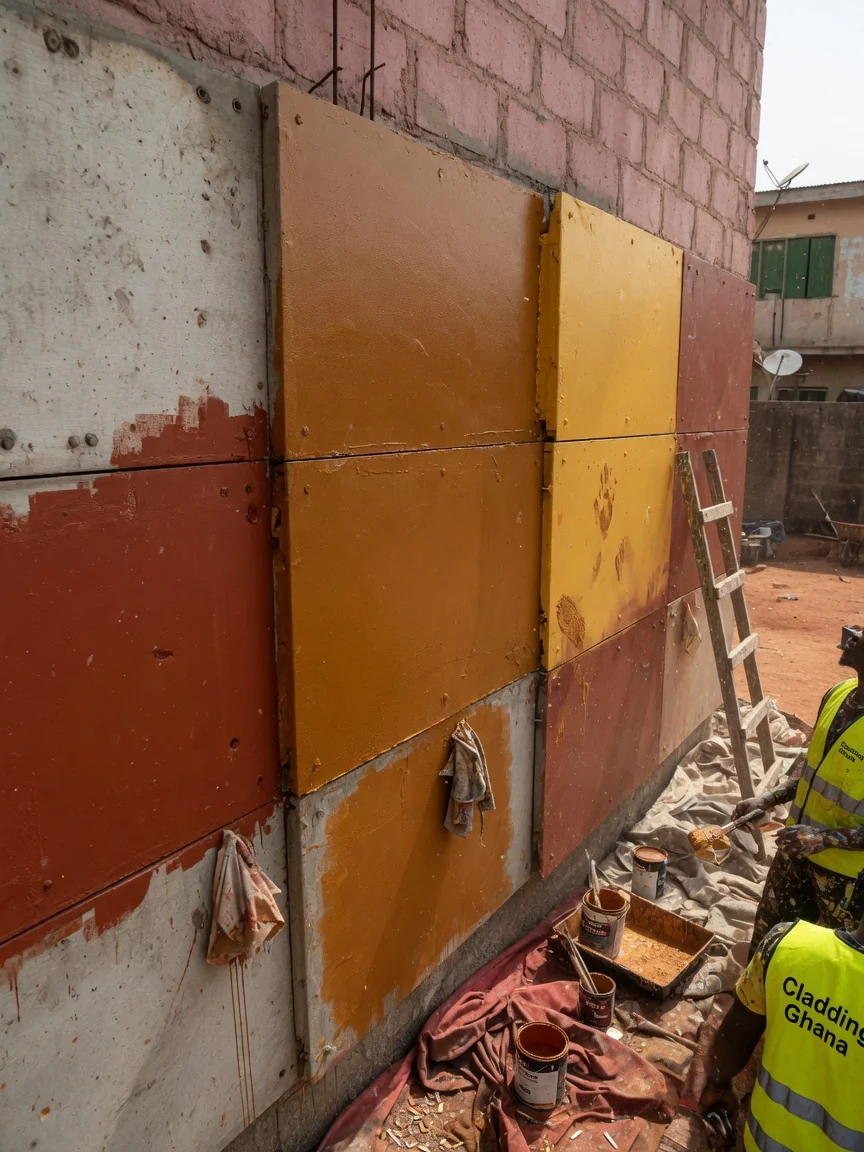
Extruded fired-clay (terracotta) baguettes or tiles hung as a ventilated rainscreen. Non-combustible, natural in appearance, and characteristic of high-end civic and cultural buildings — the warm earthy tone is its signature. Durable and colour-stable, with the ventilated cavity doing the weather and thermal work. A premium system, valued for its architectural identity as much as its performance.
High-Pressure Laminate (HPL)
Compressed resin-impregnated layers forming a tough, decorative panel with an enormous range of colours, wood-effects and patterns — the most design-flexible faces in the catalogue. Light and good value. The fire caveat matters: standard HPL is combustible, so a fire-retardant grade must be specified and the reaction-to-fire class named for any tall or occupied building. Best for low-rise, balconies, soffits and decorative accents where its look earns its place.
Fibre-Cement
Cement reinforced with cellulose fibre, in flat panels or planks. A robust, non-combustible workhorse — good durability, low maintenance, and a clean matt finish from flat colour to wood-grain. Strong value for institutional, educational and residential façades where a calm, durable surface is wanted without the premium of porcelain or stone. Heavier than ACP and benefits from a ventilated cavity in Accra’s climate.
Natural Stone Veneer
Real stone — granite, limestone, sandstone — in thin veneer panels on a support system, or as a backed lightweight panel. Inherently non-combustible, with a depth and permanence no manufactured face matches; the prestige finish for banks, hotels and institutional landmarks. The highest material and fixing cost in the family, and the heaviest, so the support structure and engineering are a real part of the decision.
Zinc & Copper Standing-Seam
Pre-weathered zinc or copper in standing-seam or interlocking panels — a non-combustible metal façade with a living, patina-ageing surface that is a deliberate architectural statement. Very long service life and low maintenance, prized on signature and heritage-influenced buildings. A premium system; the metal cost and the skilled installation set it apart from a flat panel.
WPC & Timber
Wood-plastic composite (WPC) and natural timber give a warm, organic façade — slats, screens and accent walls that soften a building. WPC resists rot and insects better than raw timber and needs less upkeep. The fire caveat is the same as HPL and timber generally: combustible unless a treated/rated grade is specified, so it belongs on low-rise, screens, soffits and accents rather than on a tall or occupied façade without an engineered, tested system.
The Comparison Table
| System | Look | Durability | Fire | Best for | Relative cost |
|---|---|---|---|---|---|
| ACP (PE/FR/A2) | Flat, modern, any colour | High (coated alloy) | Core-dependent — A2-s1,d0 to combustible PE | Commercial towers, corporate façades | Lower–mid (by core) |
| Ceramic/porcelain ventilated | Stone-effect to flat colour | Very high, fade-resistant | Non-combustible | Institutional, premium façades | Mid–high |
| Terracotta rainscreen | Warm natural clay | Very high, colour-stable | Non-combustible | Civic, cultural, landmark | High |
| HPL | Huge colour/wood-effect range | Good | Combustible (FR grade available) | Low-rise, balconies, soffits, accents | Lower–mid |
| Fibre-cement | Matt, flat or wood-grain | High | Non-combustible | Institutional, education, residential | Lower–mid |
| Natural stone veneer | Real stone, prestige depth | Very high, permanent | Non-combustible | Banks, hotels, landmarks | High |
| Zinc/copper standing-seam | Living patina, metal statement | Very high, long life | Non-combustible | Signature, heritage-influenced | High |
| WPC/timber | Warm, organic, slatted | Good (WPC > timber) | Combustible (rated grade needed) | Low-rise, screens, soffits, accents | Lower–mid |
(Fire behaviour is the material’s reaction-to-fire; the whole façade is engineered and, where required, classified to EN 13501-1. Relative cost is material-and-system indicative — the firm figure follows a survey. See the Cladding Cost Guide.)
How to Choose — In This Order
The decision is far easier when you take it in the right order. Cost is the last filter, not the first.
- Fire requirement first. Building height, use and occupancy set the reaction-to-fire class the façade must meet under EN 13501-1. On a tall or occupied building this rules out combustible options (PE-core ACP, unrated HPL/timber/WPC) before anything else — it is a life-safety decision, not a finish decision.
- Climate and exposure second. Accra’s sun, coastal salt and humidity reward a ventilated rainscreen built from a stable face material — porcelain, ceramic, terracotta, fibre-cement or an A2-core ACP. The ventilated cavity sheds heat and moisture and protects the wall behind.
- Building type and look third. A corporate tower, a civic landmark, a hospital, a school and a residence each suit a different family — flat modern ACP, prestige stone or porcelain, characterful terracotta or metal, or a warm WPC accent. The look has to fit the building’s identity and budget.
- Budget last — on value, not sheet price. A higher-priced durable system that is rarely re-clad often beats a lower-priced one that fades or fails early. The honest comparison is cost over the building’s life, which is exactly what the cost guide and a survey establish.
The Standards That Govern These Systems
- EN 13501-1 — European reaction-to-fire classification (Euroclass A1, A2, B… with s = smoke and d = droplet sub-classes); A2-s1,d0 is the target for non-combustible ACP
- EN 14411 — the standard for ceramic and porcelain tiles used in ventilated façades
- ASTM E283 / E331 / E330 — façade air leakage (E283), water penetration (E331) and structural/wind-load (E330) performance tests for the engineered system
- EN 1090 — execution of aluminium and steel structures (the sub-frame and support), with Execution Classes EXC1–4
- Coatings — PVDF, PE or FEVE finishes on metal faces, specified for weathering and colour retention separately from the fire question
Applications Across Ghana
- Corporate and bank towers in Airport City, Ridge and the CBD — ACP, porcelain and stone façades
- Hospitals and institutional buildings where non-combustible systems are specified
- Civic, cultural and landmark buildings — terracotta, stone and metal
- Schools, residences and mid-rise — fibre-cement and HPL
- Hotels and hospitality, balconies, soffits and accent walls — WPC and decorative HPL
- Commercial and institutional projects in Kumasi and Takoradi
Areas We Serve
Cladding Ghana specifies and installs façade systems across Greater Accra — Airport City, Ridge, Cantonments, the CBD, Tema, East Legon, and Spintex — plus Kumasi and Takoradi.
Related Services
- Cladding Cost Guide — GH₵/US$/CFA, material vs installed, on-survey honesty
- Aluminium Composite Cladding — ACP panel façades and fire cores
- Ceramic Ventilated Façade — porcelain and ceramic rainscreen
- Terracotta Rain-Screen — fired-clay ventilated façade
- HPL Cladding — high-pressure laminate panels
- Fibre-Cement Cladding — non-combustible cement-fibre panels
- Stone Veneer Cladding — natural stone façades
- Zinc & Copper Standing-Seam — patina metal façades
- Fast-Track Commercial Cladding — programme-critical façade delivery
Frequently Asked Questions
What are the main types of cladding used in Ghana? ACP/ACM (PE/FR/A2 cores), ceramic and porcelain ventilated façades, terracotta rainscreen, HPL, fibre-cement, natural stone veneer, zinc and copper standing-seam, and WPC/timber. Each differs on look, durability, fire and cost, so the right one is chosen against the specific building rather than on price.
Which cladding is best for a hot, humid coastal climate like Accra? A ventilated rainscreen from a stable face material handles it best — porcelain, ceramic, terracotta, quality fibre-cement, or an A2-core ACP. The ventilated cavity sheds heat and moisture and protects the wall behind. Match the material and cavity to the exposure, then to the fire requirement.
Which cladding is the most fire-safe? Non-combustible mineral systems lead — porcelain/ceramic, terracotta and natural stone — and an A2-core ACP is classified A2-s1,d0 under EN 13501-1. Treat PE-core ACP (the Grenfell material), unrated HPL and timber with caution: not for tall or occupied buildings without an engineered, tested system.
How do I choose between cladding systems? In order: fire requirement first, then exposure (Accra sun, salt, humidity), then look and budget. Fire and exposure narrow the shortlist; look and value choose within it. A durable system rarely re-clad often beats a lower-priced one that fails early — decide on value over the building life.