
Why Multinational HQs in Accra Specify Cladding Ghana
A multinational headquarters façade is a brand statement set in built form. It has to read as global-grade from the street, satisfy a head-office fire and compliance standard that does not flex for a local market, and hold its finish through Accra sun, coastal salt and humidity without the kind of maintenance that embarrasses a flagship building. Cladding Ghana has specified and installed façade systems across Ghana since 1983, and on corporate HQ work we are deliberately system-agnostic: our job is to put the right cladding on the building, name it in writing, and tell you the honest trade-offs.
The HQ decision is taken in order — fire requirement first, exposure second, then look and budget — because a corporate tower is tall and occupied, and the reaction-to-fire class is fixed before the architectural conversation begins. International tenants and head-office estates teams increasingly insist on a non-combustible or limited-combustibility façade as a documented baseline, which is exactly the conversation we start with.
What Multinational HQ Façades Demand
Brand-grade appearance
A headquarters is judged on first impression. The façade must carry the corporate identity at scale — a flat, precise, any-colour ACP elevation, a dense porcelain frontage, or the permanence of natural stone at the entrance. The look has to be deliberate and consistent across the whole elevation.
Fire safety to head-office standard
A corporate tower is occupied and often tall, so the façade must meet its reaction-to-fire class under EN 13501-1. International occupiers expect a non-combustible or A2-s1,d0 (limited-combustibility) façade named in writing — which rules out a PE-core ACP at the outset.
Low maintenance on a flagship
A flagship cannot look tired. A ventilated rainscreen from a stable face material sheds heat and moisture, protects the wall behind, and needs little more than washing — keeping the building presentation-ready for years.
Weathering and colour retention
Accra’s sun and coastal exposure punish weak coatings. PVDF and FEVE finishes on metal faces, and the inherent colour-stability of porcelain and stone, hold the brand colour through the building’s life.
Choosing the Right Cladding System for Multinational HQs
The HQ shortlist is built for presence and compliance:
- A2-core ACP — flat, modern, any RAL or anodised finish, classified A2-s1,d0 (limited combustibility); the corporate-tower default where a precise, brand-coloured elevation is wanted.
- Porcelain / ceramic ventilated façade — inherently non-combustible to EN 14411, dense, fade-resistant and low-maintenance; a premium, durable institutional finish from stone-effect to flat colour.
- Natural stone veneer — real granite, limestone or sandstone with a depth and permanence no manufactured face matches; the prestige finish for entrance elevations and HQ landmarks, inherently non-combustible.
A PE-core ACP is ruled out, and unrated HPL or timber is kept to soffits and accents only. The choice within the shortlist is made on appearance, service life and relative cost — decided on value over the building life, not the lowest sheet price.
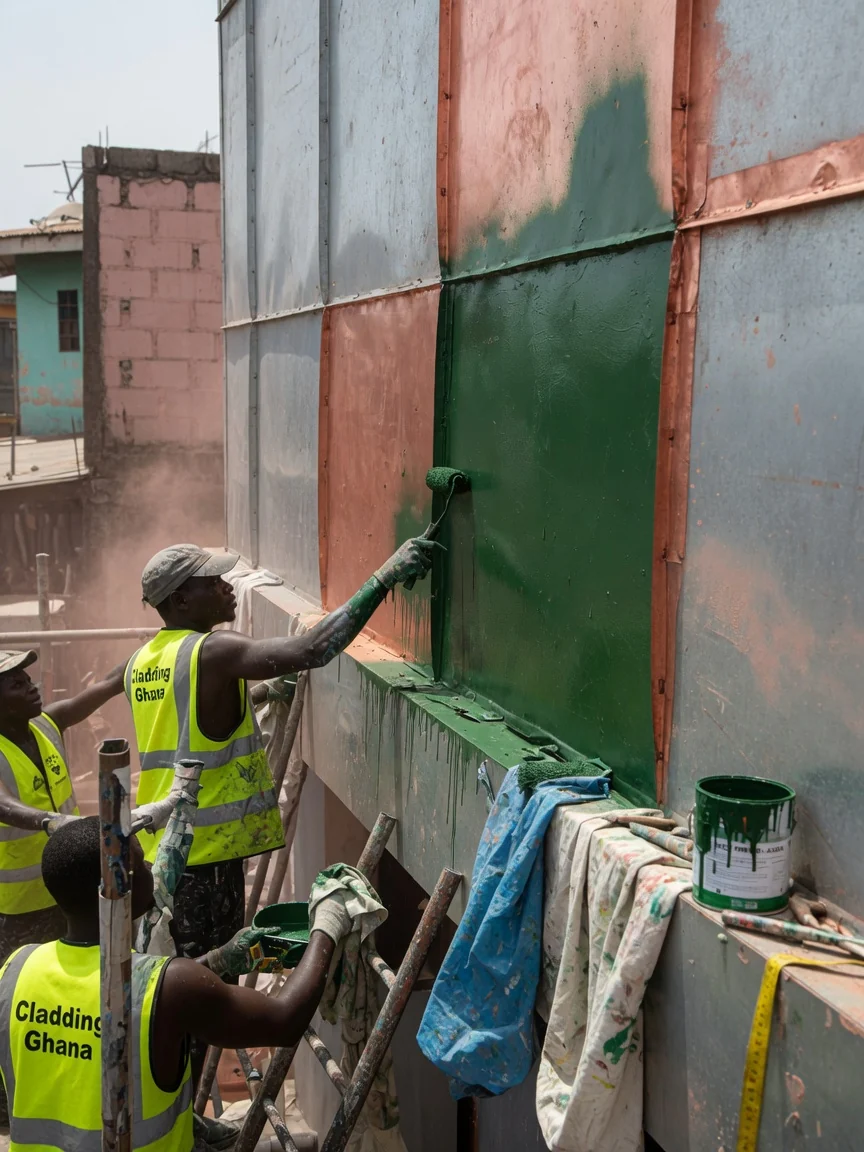
Our Multinational HQ Cladding Scope
- Types of Cladding Compared — the honest side-by-side of every system, and how to choose for a corporate HQ
- Ceramic Ventilated Façade — porcelain and ceramic rainscreen, the non-combustible brand-grade frontage
- HPL Cladding — fire-retardant-grade laminate for soffits and decorative accents only
- Fibre-Cement Cladding — non-combustible cement-fibre panels for back-of-house and support elevations
- Cladding Cost Guide — material vs installed, on-survey honesty
Standards & Performance
- EN 13501-1 — reaction-to-fire classification (Euroclass A1, A2…; A2-s1,d0 is the target for non-combustible ACP); the head-office baseline for an occupied corporate tower
- EN 14411 — the standard for the ceramic and porcelain tiles used in ventilated façades
- ASTM E283 / E331 / E330 — façade air leakage (E283), water penetration (E331) and structural wind-load (E330) tests for the engineered system
- Material specifics — coating systems (PVDF, FEVE) for colour retention, porcelain density, and stone permanence are qualitative selection factors confirmed against the specific building
Firm cost follows a survey — the honest figure depends on the building, its height and its exposure.
Multinational HQ Façades Across Accra
Cladding Ghana specifies and installs corporate headquarters and tower façades across Greater Accra — Airport City, Ridge, Cantonments, the CBD, East Legon and Tema — plus Kumasi and Takoradi. Wherever the HQ stands, the method is the same: fix the fire class first, match the material and cavity to the exposure, and name the chosen system in writing.