
Why Industrial & Warehouse Specify Cladding Ghana
An industrial or warehouse building has large, simple elevations and an unforgiving brief: clad a lot of area, fast, to a budget, with a façade that takes punishment and keeps the building watertight for decades. Tema’s industrial estate adds coastal salt and heat to the equation. Cladding Ghana has specified and installed façade systems across Ghana since 1983, and we are deliberately system-agnostic — we put the right cladding on the building for durability and speed, name its fire class in writing, and tell you the honest trade-offs.
Industrial work is where programme and value dominate. There is rarely a prestige requirement; there is always a watertight-date and a cost ceiling. We specify the substrate, the sub-frame and the install sequence to hit both.
What Industrial & Warehouse Façades Demand
Durability under hard use
Industrial elevations take impact, abrasion, plant traffic and coastal weathering. A robust, non-combustible workhorse face — fibre-cement flat sheet or a coated metal/A2-core ACP — on a properly engineered ventilated cavity gives a hard-wearing surface that does not chalk, dent or fail early in Tema’s climate.
Speed of erection on large elevations
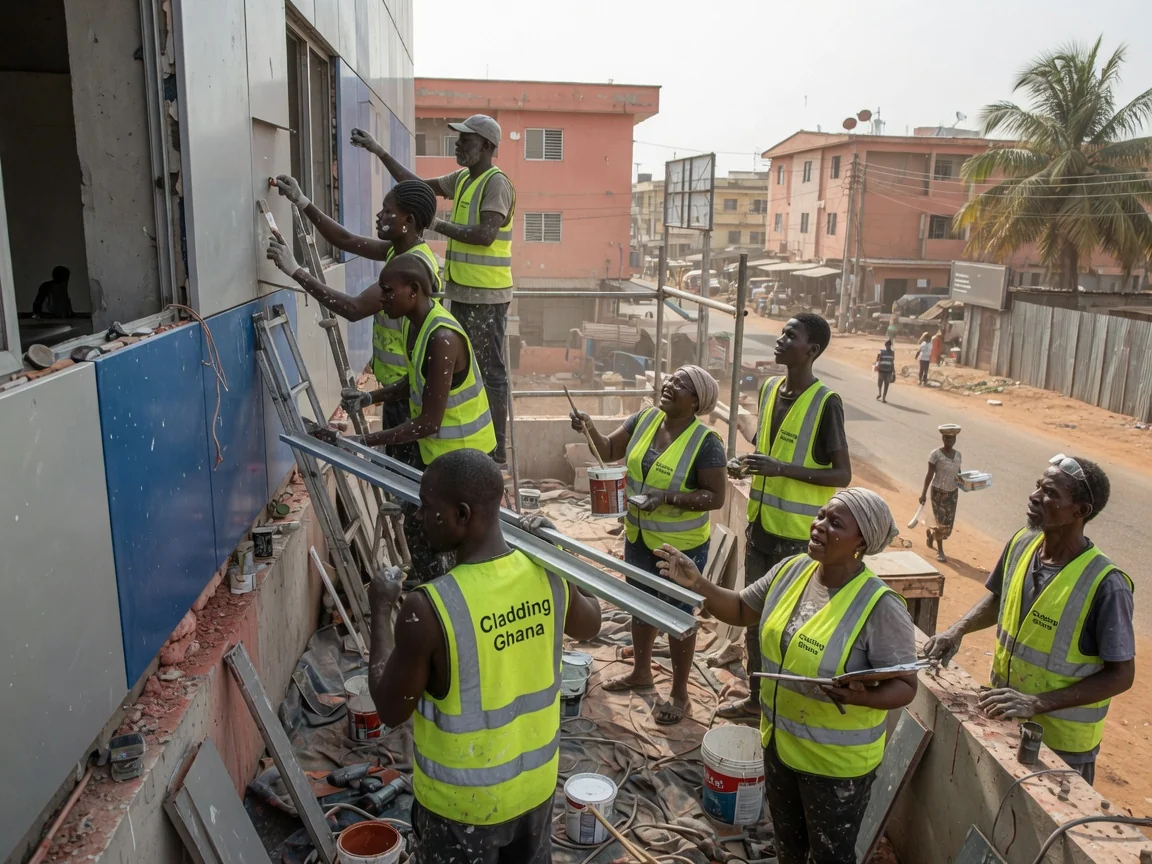
A warehouse is mostly façade, so the rate of install drives the programme. Lightweight rainscreen panels on a rail-and-bracket sub-frame, and prefabricated panels assembled off-site, let large elevations go up fast and watertight — keeping the building dry while the fit-out proceeds inside.
Value over the building life
Industrial budgets are tight, and the honest comparison is cost over the building life, not the sheet price. A durable, low-maintenance fibre-cement or coated-metal face that is rarely touched again beats a face that needs re-coating or re-cladding within a few seasons.
A named fire class
Even on an industrial building the reaction-to-fire class is named — set by occupancy, stored goods and any office/mezzanine zones — and combustible options are ruled out where the building demands a limited-combustibility or non-combustible façade.
Choosing the Right Cladding System for Industrial Buildings
Substrate selection
The substrate is chosen for durability, speed and value. Fibre-cement flat sheet is the non-combustible industrial workhorse — robust, low-maintenance, a clean matt finish over large areas. A coated-metal or A2-core ACP rainscreen gives a fast, light, fire-rated face for offices, entrances and feature elevations. Where programme is critical, prefabricated cladding panels built off-site on a sub-frame drop the on-site install time. Each is hung on a ventilated cavity sized for Tema’s heat and coastal humidity.
Our Industrial Cladding Scope
- Types of Cladding Compared — the system-agnostic guide we use to weigh durability, speed and value against the building
- Fibre-Cement Cladding — non-combustible cement-fibre flat sheet for large industrial elevations
- Fast-Track Commercial Cladding — phased, watertight-first delivery to a tight programme
- Stone Veneer Cladding — natural stone façades for entrance and headquarters zones where a statement is wanted
- Cladding Cost Guide — material vs installed, value over the building life, on-survey honesty
Standards & Performance
- EN 13501-1 — European reaction-to-fire classification (Euroclasses A1, A2, B…, with s = smoke and d = droplet sub-classes); A2-s1,d0 is the target for any ACP, and fibre-cement is inherently non-combustible
- EN 14411 — the standard governing the porcelain and ceramic tiles used where a ventilated tile façade is specified on office or feature zones
- ASTM E283 — air leakage of the installed façade
- ASTM E331 — water penetration under static pressure — central to keeping a warehouse watertight
- ASTM E330 — structural performance under wind load — important on tall, exposed warehouse walls
- Material specifics — coated-metal and PVDF finishes specified for coastal weathering; rail-and-bracket sub-frame engineered for large spans; prefabricated panels detailed for fast, watertight erection
Industrial & Warehouse Façades Across Accra
Industrial and warehouse work concentrates around Tema — the harbour, the free zone and the industrial estate — with logistics and light-industrial buildings along the Spintex corridor and operational facilities elsewhere in Greater Accra including Ridge and Airport City support buildings. Cladding Ghana also delivers industrial façades in Kumasi and Takoradi — the same substrate-led method, the same named fire classes, the same on-survey costing wherever the building stands.