
Why Embassies & Diplomatic Buildings Specify Cladding Ghana
An embassy is a piece of one nation standing on the soil of another, and its building has to say so. The façade must carry diplomatic gravitas, present a secure and dignified face to the street, and hold that register for decades through Accra’s sun, coastal salt and humidity. Cladding Ghana has specified and installed façade systems across Ghana since 1983, and we are deliberately system-agnostic — we put the right cladding on the building to achieve both the gravitas and the performance, name its fire class in writing, and tell you the honest trade-offs.
Diplomatic work carries the strictest combination of requirements in the empire: gravitas, security, life-safety and documentation, all at once. The reaction-to-fire class is settled first, the security and robustness of the ground-floor and perimeter zones are engineered, and the look is chosen within those constraints — never the other way round.
What Embassy Façades Demand
Diplomatic gravitas
A chancery or ambassador’s residence reads as the face of a nation, so the façade needs depth and permanence — natural stone veneer for the prestige of a landmark, terracotta or zinc/copper standing-seam for a distinctive architectural identity, or a restrained porcelain ventilated façade for a calm, institutional dignity. The material has to look the part on day one and still look the part a generation later.
Security and robustness
Diplomatic buildings are security-sensitive at ground level and along the perimeter. A robust, non-combustible substrate on a properly engineered sub-frame, with concealed undercut-anchor fixings and a hard-wearing face, gives a secure, tamper-resistant elevation rather than a thin sheet that dents or can be prised.
A non-combustible, named fire class
On an occupied diplomatic building the combustible options — PE-core ACP (the Grenfell material), unrated HPL and timber — are ruled out before look or budget. The default is a non-combustible mineral system or an A2-s1,d0 ACP, with the fire class named in the specification — a life-safety decision, documented.
Choosing the Right Cladding System for Diplomatic Buildings
Substrate selection
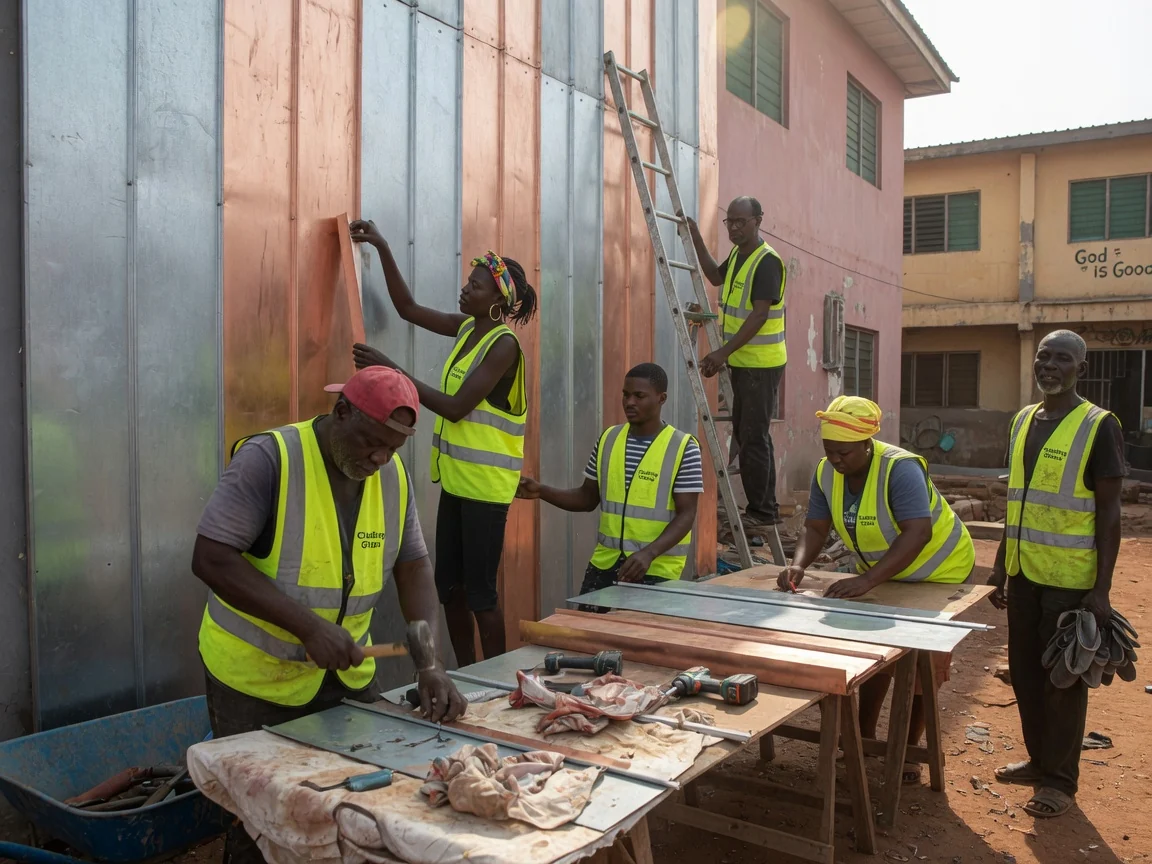
The substrate is chosen for gravitas, security and durability together. For a chancery or residence where prestige leads, natural stone veneer carries a depth and permanence no manufactured face matches. For a distinctive, living architectural signature, zinc or copper standing-seam ages to a patina that reads as deliberate and durable. For a calm, low-maintenance institutional finish, a porcelain ventilated façade to EN 14411 shrugs off sun and salt. Each is non-combustible, hung on a ventilated cavity engineered for Accra’s coastal climate and for the security of the elevation.
Our Embassy Cladding Scope
- Types of Cladding Compared — the system-agnostic guide we use to shortlist the right substrate for gravitas and security
- Stone Veneer Cladding — natural stone façades for chanceries, residences and landmark frontages
- Fibre-Cement Cladding — non-combustible cement-fibre rainscreen for ancillary and perimeter buildings
- Fast-Track Commercial Cladding — programme-critical delivery for occupied, secure compounds
- Cladding Cost Guide — material vs installed, value over the building life, on-survey honesty
Standards & Performance
- EN 13501-1 — European reaction-to-fire classification (Euroclasses A1, A2, B…, with s = smoke and d = droplet sub-classes); A2-s1,d0 is the target for any ACP on an occupied diplomatic building, and porcelain, terracotta, stone and metal are inherently non-combustible
- EN 14411 — the standard governing the porcelain and ceramic tiles used in ventilated façades
- ASTM E283 — air leakage of the installed façade
- ASTM E331 — water penetration under static pressure
- ASTM E330 — structural performance under wind load — relevant on exposed diplomatic elevations
- Material specifics — pre-weathered zinc/copper or PVDF-coated faces for colour and patina stability; concealed undercut-anchor fixings for a secure, tamper-resistant elevation; ventilated cavity sized for Accra’s heat and humidity
Embassy Façades Across Accra
Diplomatic and embassy work concentrates in Cantonments — Accra’s diplomatic quarter — with chanceries and residences extending into Ridge and Airport City, and consular and operational buildings elsewhere in Greater Accra including Tema. Cladding Ghana also delivers diplomatic and institutional façades in Kumasi and Takoradi — the same substrate-led method, the same named fire classes, the same on-survey costing wherever the building stands.